
Variables
Description
What is this formula?
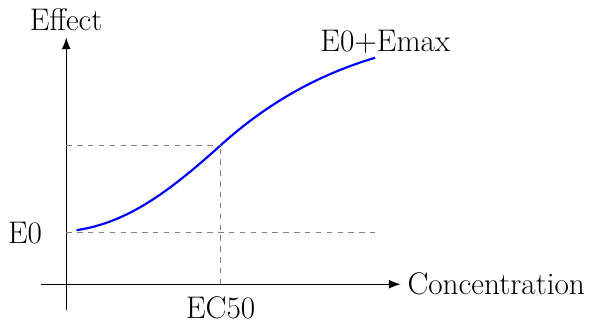
The Baseline Emax Model extends the classical Emax model by incorporating a baseline response that exists before drug administration.
Instead of assuming that the response starts at zero, the model assumes an initial effect level (E0) and then adds the drug-induced response on top of that baseline.
This makes the model suitable for physiological variables, biomarkers, and clinical endpoints that have nonzero values before treatment.
When to use it
Use this model when:
- A measurable baseline response exists
- Drug effect is additive to the baseline
- Modeling biomarkers or physiological variables
- Performing PK/PD analyses
- Fitting concentration–effect data with nonzero initial values
Example
Given:
E0 = 20
Emax = 80
EC50 = 4 mg/L
C = 8 mg/L
Formula:
E = E0 + (Emax × C)/(EC50 + C)
Substitution:
E = 20 + (80 × 8)/(4 + 8)
E = 20 + 640/12
E = 73.3
Result:
The predicted effect is approximately 73.3 units.
Applications
- Clinical pharmacology
- Biomarker modeling
- Pharmacodynamics
- PK/PD simulations
- Drug development
- Therapeutic response analysis
Note
The Baseline Emax Model is an empirical pharmacodynamic model. It assumes that drug action adds to an existing baseline value. Other formulations may assume proportional, multiplicative, or inhibitory effects depending on the biological mechanism and the measured endpoint.