
Variables
Description
What is this formula?
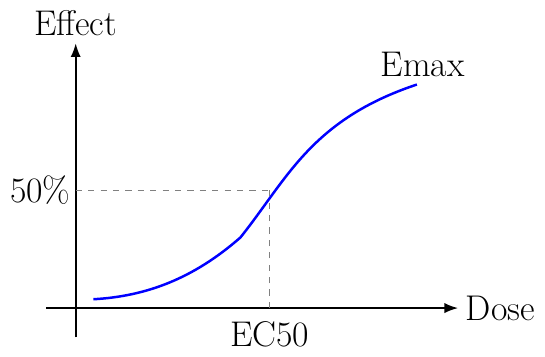
The Hill Dose–Response Equation describes how the pharmacological effect of a drug changes as its concentration increases. It produces the characteristic sigmoidal dose–response curve widely used in pharmacology, toxicology, receptor studies, and drug development.
The equation relates drug concentration to effect using three key parameters: maximum effect (Emax), half-maximal effective concentration (EC50), and the Hill coefficient (n), which controls the steepness of the response curve.
When to use it
Use this equation when modeling concentration–effect relationships for drugs, agonists, hormones, neurotransmitters, or other biologically active compounds that exhibit saturable responses.
It is commonly used for:
- Pharmacodynamic modeling
- Receptor activation studies
- Drug potency comparisons
- Dose selection during drug development
- Toxicological response analysis
Example
A drug has:
Emax = 100%
EC50 = 5 mg/L
n = 2
C = 10 mg/L
Formula:
E = (Emax × C²) / (EC50² + C²)
Substitution:
E = (100 × 10²) / (5² + 10²)
E = 10000 / 125
E = 80%
Result:
The predicted pharmacological effect is 80% of the maximum possible response.
Applications
- Pharmacokinetic/pharmacodynamic (PK/PD) modeling
- Drug efficacy studies
- Receptor pharmacology
- Clinical dose optimization
- Toxicology and risk assessment
- Biopharmaceutical research
Note
The Hill equation is a phenomenological model rather than a fundamental physical law. The Hill coefficient is often interpreted as a measure of cooperativity, but in many experimental systems it primarily reflects the steepness of the observed response curve. Alternative dose–response models such as the Sigmoid Emax and Log-Logistic models are also widely used depending on the application and available data.