
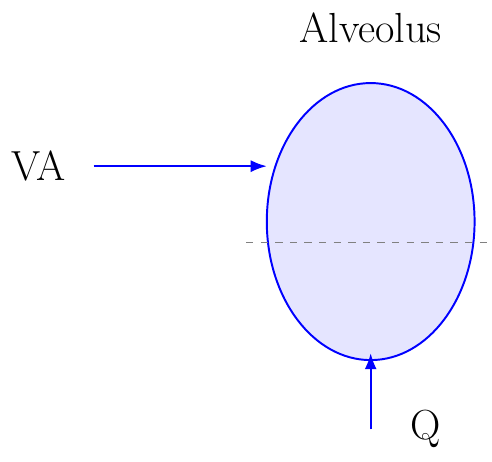
Variables
Description
What is this formula?
The Ventilation–Perfusion Ratio (V/Q ratio) describes the relationship between alveolar ventilation and pulmonary blood flow. It is one of the most important indicators of gas exchange efficiency in the lungs.
When to use it
Use this formula when evaluating pulmonary gas exchange, studying respiratory physiology, assessing hypoxemia, or analyzing ventilation-perfusion mismatch.
Example
Data:
VA = 4.2 L/min
Q = 5.0 L/min
Formula:
VQ = VA / Q
Substitution:
VQ = 4.2 / 5.0
VQ = 0.84
Result:
Ventilation–Perfusion Ratio = 0.84
Applications
- Pulmonary physiology
- Respiratory medicine
- Critical care
- Evaluation of pulmonary embolism
- Assessment of chronic lung disease
Note
The V/Q ratio is a physiological model rather than a fixed law. Different regions of the lung normally have different V/Q values due to gravity and regional differences in ventilation and blood flow. A value near 0.8 is often considered normal for the entire lung.