
Variables
Description
What is this formula?
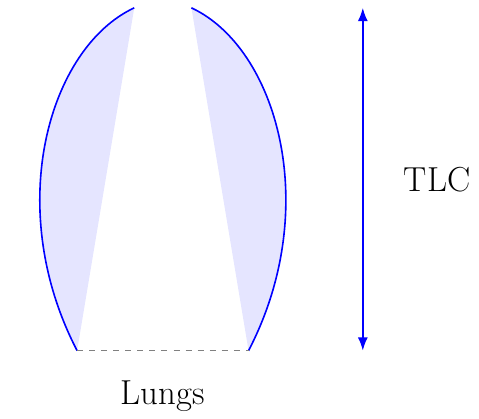
Predicted Total Lung Capacity (TLC) estimates the total volume of air contained in the lungs after a maximal inspiration. It is one of the primary reference values used to assess restrictive lung disorders.
When to use it
Use this formula when evaluating lung volumes, diagnosing restrictive pulmonary disease, interpreting body plethysmography results, or comparing measured TLC with expected normal values.
Example
Data:
Male
Height = 175 cm
Age = 40 years
Formula:
TLCmale = 0.089H − 0.019A − 7.33
Substitution:
TLCmale = (0.089 × 175) − (0.019 × 40) − 7.33
TLCmale = 15.575 − 0.760 − 7.330
TLCmale = 7.49 L
Result:
Predicted TLC = 7.49 L
Applications
- Body plethysmography
- Pulmonary function laboratories
- Restrictive lung disease assessment
- Occupational medicine
- Respiratory physiology
Note
This equation is an empirical prediction model derived from specific population studies. Numerous alternative reference equations exist, and modern pulmonary laboratories may use GLI-based or region-specific reference standards. Results should be interpreted according to local clinical guidelines.