
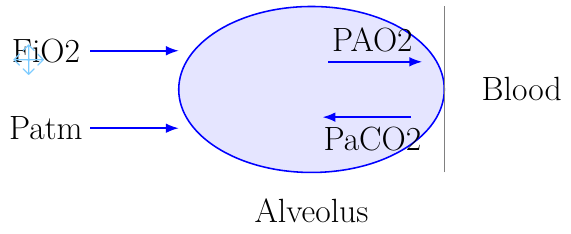
Variables
Description
What is this formula?
The Alveolar Gas Equation estimates the partial pressure of oxygen in the alveoli. It is one of the most important equations in respiratory physiology because it links inspired oxygen, atmospheric pressure, carbon dioxide levels, and metabolic gas exchange.
When to use it
Use this equation when evaluating oxygenation status, calculating the alveolar-arterial oxygen gradient, interpreting arterial blood gases, assessing respiratory failure, or studying pulmonary physiology.
Example
Data:
FiO2 = 0.21
Patm = 760 mmHg
PH2O = 47 mmHg
PaCO2 = 40 mmHg
RQ = 0.8
Formula:
PAO2 = FiO2(Patm − PH2O) − PaCO2/RQ
Substitution:
PAO2 = 0.21(760 − 47) − 40/0.8
PAO2 = 149.7 − 50
PAO2 = 99.7 mmHg
Result:
PAO2 ≈ 100 mmHg
Applications
- Arterial blood gas interpretation
- A–a oxygen gradient calculation
- Critical care medicine
- Pulmonology
- Mechanical ventilation assessment
- High-altitude physiology