
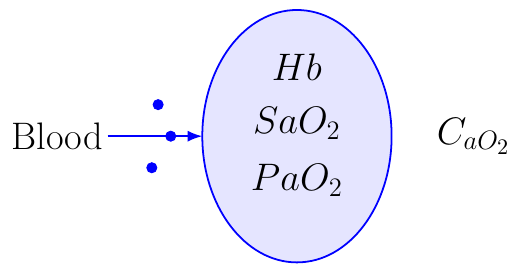
Variables
Description
What is this formula?
The Oxygen Content of Arterial Blood formula calculates the total amount of oxygen carried in arterial blood. It includes oxygen bound to hemoglobin and oxygen dissolved in plasma.
When to use it
Use this formula when evaluating oxygen transport, respiratory function, cardiovascular performance, or critically ill patients.
Example
Data:
Hb = 15 g/dL
SaO2 = 0.98
PaO2 = 100 mmHg
Formula:
CaO₂ = (1.34 × Hb × SaO₂) + (0.0031 × PaO₂)
Substitution:
CaO₂ = (1.34 × 15 × 0.98) + (0.0031 × 100)
CaO₂ = 19.70 + 0.31
Result:
CaO₂ = 20.01 mL O₂/dL
The arterial blood contains approximately 20.0 mL of oxygen per deciliter of blood.
Applications
- Critical care medicine
- Respiratory physiology
- Anesthesia
- Cardiology
- Oxygen transport assessment
Note
This formula is a clinical model based on standard oxygen-carrying properties of hemoglobin and oxygen solubility in plasma. The coefficient 1.34 mL O₂/g Hb may vary slightly among references, with values between 1.34 and 1.39 commonly reported. The dissolved oxygen component is usually small compared with hemoglobin-bound oxygen under normal physiological conditions.