
Variables
Description
What is this formula?
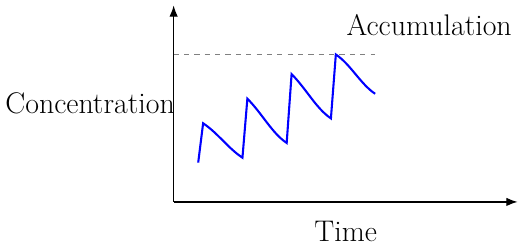
The Accumulation Factor (AF) quantifies how much a drug accumulates in the body during repeated dosing compared with a single dose. It depends on the elimination rate and dosing interval.
When to use it
Use this formula when evaluating repeated-dose regimens, predicting steady-state concentrations, and assessing the impact of dosing frequency on drug accumulation.
Example
Data:
k = 0.1 1/h
tau = 12 h
Formula:
AF = 1/(1 − ℮^(-k×tau))
Substitution:
AF = 1/(1 − ℮^(-0.1×12))
Result:
AF = 1.43
Applications
- Pharmacokinetic modeling
- Repeated-dose regimen design
- Drug accumulation studies
- Therapeutic drug monitoring
- Clinical pharmacology
Note
This formula is derived from a one-compartment pharmacokinetic model with first-order elimination. It assumes constant pharmacokinetic parameters and complete adherence to the dosing schedule. Real-world accumulation may differ due to nonlinear kinetics, variable absorption, drug interactions, and patient-specific factors.