
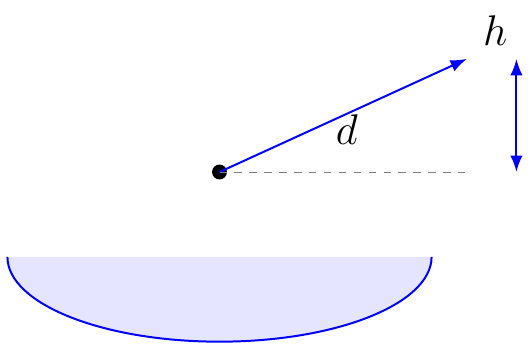
Variables
Description
What is this formula?
The Radio Horizon Distance estimates the maximum line-of-sight distance between an antenna and the radio horizon due to Earth's curvature. It is widely used for preliminary radio link planning.
When to use it
Use this formula when estimating communication range, planning radio networks, designing broadcast systems, evaluating antenna sites, or performing preliminary microwave link studies.
Example
A communication tower supports an antenna at a height of 100 m above ground.
Formula:
d = 3.57√(h)
Substitution:
d = 3.57√(100)
d = 3.57×10
Result:
d = 35.7 km
The radio horizon is approximately 35.7 km from the antenna.
Applications
Broadcast radio, television transmission, cellular networks, microwave links, marine communications, aviation communications, and radio network planning.
Nota
This formula is an engineering approximation that assumes standard atmospheric refraction and average Earth curvature conditions. Actual radio horizons may be longer or shorter depending on atmospheric conditions, terrain, antenna characteristics, and local propagation effects. Alternative versions of the formula use slightly different coefficients depending on the assumed effective Earth radius model.