
Variables
Description
What is this formula?
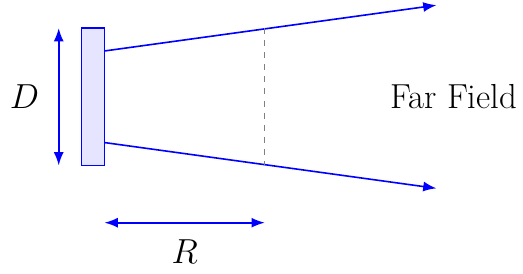
The Antenna Far-Field Distance defines the minimum distance at which the electromagnetic field radiated by an antenna can be considered a plane wave. Beyond this distance, the antenna radiation pattern becomes essentially independent of distance.
When to use it
Use this formula when performing antenna measurements, gain testing, radiation pattern characterization, electromagnetic compatibility studies, or designing antenna test ranges.
Example
An antenna has a largest dimension of 2 m and operates at a wavelength of 0.1 m.
Formula:
R = (2D²)/λ
Substitution:
R = (2×2²)/0.1
R = (2×4)/0.1
Result:
R = 80 m
The far-field region begins approximately 80 m from the antenna.
Applications
Antenna testing, RF measurement ranges, radar systems, satellite communications, electromagnetic compatibility testing, wireless communications, and antenna design.
Note
This formula is known as the Fraunhofer distance criterion and is widely accepted for practical antenna engineering. It provides an approximation of the transition between the radiating near-field and far-field regions. More detailed criteria may be used for very large antennas, phased arrays, or specialized measurement applications.