
Variables
Description
What is this formula?
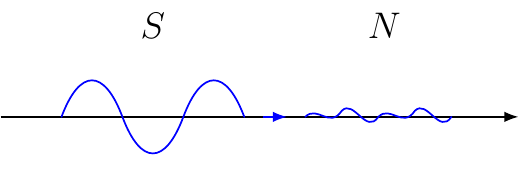
Signal-to-Noise Ratio (SNR) measures how strong a desired signal is compared to the background noise affecting it. It is one of the most important indicators of communication system quality.
When to use it
Use this formula when evaluating communication links, audio systems, wireless networks, radio receivers, measurement systems, or any application where signal quality must be quantified.
Example
A receiver measures a signal power of 2 mW and a noise power of 0.01 mW.
Formula:
SNR = Ps/Pn
Substitution:
SNR = 2/0.01
Result:
SNR = 200
SNR = 23.01 dB
Applications
Wireless communications, radio systems, cellular networks, satellite links, audio engineering, instrumentation systems, radar systems, and digital communications.
Note
SNR is a performance metric rather than a physical law. In practice, SNR is commonly expressed in decibels using SNRdB = 10·log10(SNR). Actual system performance may also depend on modulation type, coding, interference, fading, and receiver implementation.