
Variables
Description
What is this formula?
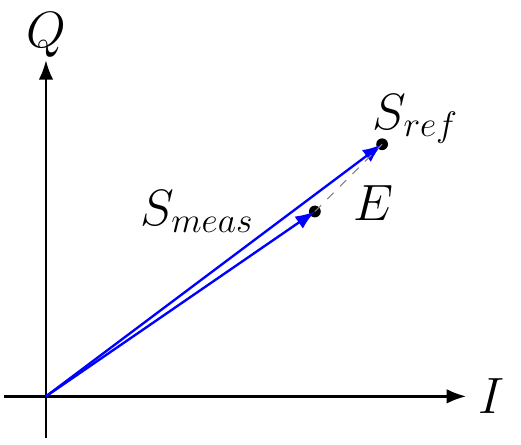
Error Vector Magnitude (EVM) measures the difference between an ideal reference signal constellation point and the actual received signal point. It is one of the most important indicators of modulation quality in modern digital communication systems.
When to use it
Use this formula when evaluating modulation accuracy, transmitter quality, receiver performance, signal impairments, or compliance with wireless communication standards.
Example
A measured QAM signal has an RMS error vector magnitude of 0.02 V and an RMS reference signal magnitude of 1.0 V.
Formula:
EVM = E/Sref
Substitution:
EVM = 0.02/1.0
Result:
EVM = 0.02
EVM = 2%
Applications
Wi-Fi systems, LTE networks, 5G communications, satellite communications, software-defined radio, modulation testing, RF transmitter verification, and communication system optimization.
Note
EVM is a practical performance metric rather than a fundamental physical law. Real communication standards often specify EVM limits as a percentage or in decibels. Measured EVM can be affected by noise, phase noise, nonlinear distortion, IQ imbalance, frequency offset, and other implementation imperfections. Different standards may use slightly different EVM calculation procedures.