
Variables
Description
What is this formula?
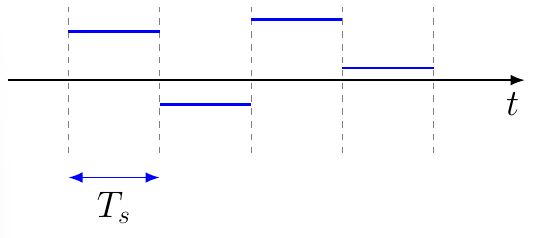
Symbol rate, also called baud rate, represents the number of transmitted symbols per second in a digital communication system. It relates the bit rate to the number of modulation states used by the modulation scheme.
When to use it
Use this formula when designing digital communication systems, evaluating bandwidth efficiency, comparing modulation schemes, or calculating transmission parameters for modems and wireless systems.
Example
A communication system transmits data at 12 Mbps using 16-QAM modulation.
Formula:
Rs = Rb/log2(M)
Substitution:
Rs = 12000000/log2(16)
Rs = 12000000/4
Result:
Rs = 3000000 symbols/s
Rs = 3 Mbaud
Applications
Digital communications, QPSK systems, QAM systems, satellite communications, wireless networks, modem design, and spectral efficiency analysis.
Note
This formula assumes ideal modulation where each symbol carries exactly log2(M) bits. In practical systems, channel coding, pilot symbols, synchronization overhead, and protocol framing can reduce the effective user data rate relative to the theoretical symbol rate.