
Variables
Description
What is this formula?
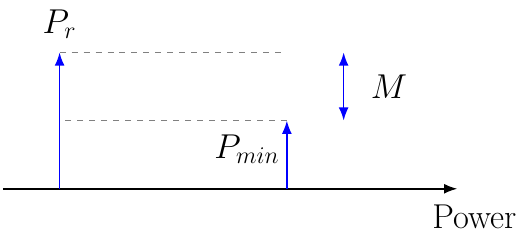
Link Margin measures how much the received signal power exceeds the minimum receiver sensitivity required for reliable communication. It indicates the safety margin available in a link budget.
When to use it
Use this formula when evaluating wireless links, microwave paths, satellite links, cellular coverage, radio networks, or any communication system where received power must remain above the receiver threshold.
Example
A receiver obtains a signal power of -72 dBm. The receiver sensitivity is -90 dBm.
Formula:
M = Pr - Pmin
Substitution:
M = -72 - (-90)
Result:
M = 18 dB
The link has an 18 dB margin.
Applications
RF link budgets, satellite communications, microwave links, cellular network planning, Wi-Fi coverage analysis, telemetry systems, and radio system reliability studies.
Note
Link margin is a practical engineering metric, usually calculated in decibels. A positive margin means the received signal is above the receiver sensitivity threshold, while a negative margin indicates that the link may fail. Real-world design often requires additional fade margin to account for rain attenuation, multipath fading, antenna misalignment, cable losses, interference, and environmental variability.