
Variables
Description
What is this formula?
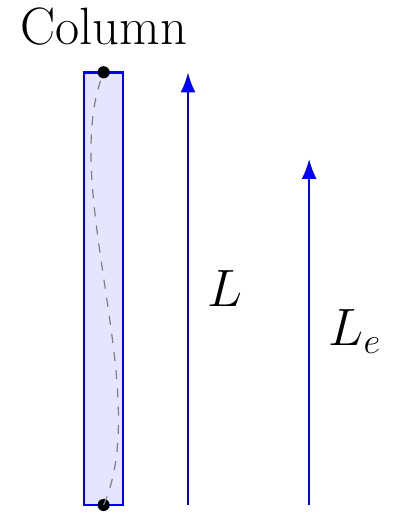
The effective length factor relates the effective buckling length of a column to its actual unsupported length. It accounts for the influence of end restraints and support conditions on column stability.
When to use it
Use this formula when determining the effective length required for buckling calculations, slenderness ratio calculations, and column design according to structural design codes.
Example
A steel column has:
L = 4.0 m
K = 0.80
Formula:
Le = K × L
Substitution:
Le = 0.80 × 4.0
Result:
Le = 3.20 m
Applications
Column design, Euler buckling calculations, steel structures, reinforced concrete columns, structural stability analysis, industrial buildings, and bridge structures.
Note
The effective length factor depends on boundary conditions and end restraint stiffness. Typical values range from approximately 0.5 for highly restrained columns to 2.0 for cantilever columns. Structural design standards provide recommended values and alignment charts for determining K under different support conditions.