
Variables
Description
What is this formula?
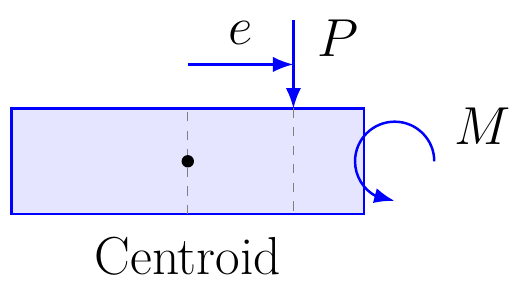
Eccentric load stress calculates the normal stress produced when an axial load is applied away from the centroid of a structural member. The eccentricity creates an additional bending moment equal to P·e, causing the stress distribution to become non-uniform.
When to use it
Use this formula for columns, foundations, brackets, machine supports, retaining structures, and structural members subjected to loads that do not pass through the centroid.
Example
A steel column is subjected to:
P = 150000 N
A = 0.008 m²
e = 0.05 m
c = 0.10 m
I = 0.00008 m⁴
Formula:
σmax = P/A + (P·e·c)/I
Substitution:
σmax = 150000/0.008 + (150000×0.05×0.10)/0.00008
Result:
σmax = 28,125,000 Pa
Result:
σmax = 28.1 MPa
Applications
Columns, bearing walls, foundations, anchor systems, machine bases, steel structures, reinforced concrete members, and structural stability checks.