
Variables
Description
What is this formula?
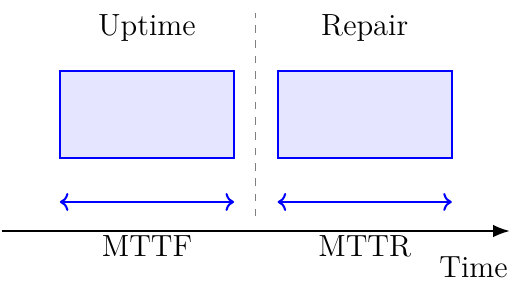
Software Availability measures the fraction of total time that a software system is operational and capable of providing its intended service.
It combines reliability and maintainability by considering both how often failures occur and how quickly they are repaired.
Availability is one of the most important metrics used in cloud computing, DevOps, site reliability engineering (SRE), and mission-critical software systems.
When to use it
Use this formula when:
- evaluating service uptime,
- defining service-level agreements (SLAs),
- comparing system reliability,
- assessing maintenance effectiveness,
- monitoring cloud and enterprise applications.
Example
A software platform has:
MTTF = 500 h
MTTR = 5 h
Formula:
A = MTTF / (MTTF + MTTR)
Substitution:
A = 500 / (500 + 5)
A = 500 / 505
A = 0.9901
Result:
Availability = 0.9901
Availability = 99.01%
Applications
- Site Reliability Engineering (SRE)
- Cloud computing
- Enterprise software
- Telecommunications
- Industrial automation systems
- Mission-critical applications
Note
Availability is a probabilistic performance metric based on historical reliability and repair data. Actual availability may differ due to planned maintenance, catastrophic failures, network outages, dependency failures, or operational constraints. Different organizations may calculate availability using slightly different definitions depending on SLA requirements.