
Variables
Description
What is this formula?
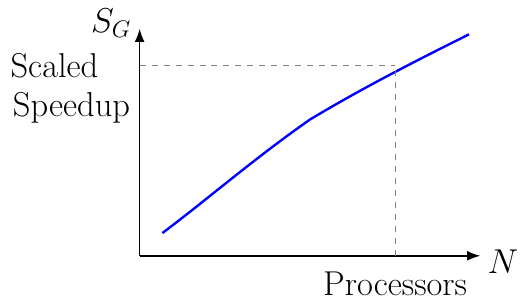
Gustafson's Law estimates the speedup achievable in a parallel system when the workload grows as additional processors become available.
Unlike Amdahl's Law, which assumes a fixed problem size, Gustafson's Law assumes that larger problems can be solved using the extra computational resources.
This makes it particularly useful for evaluating modern high-performance computing systems.
When to use it
Use this formula when:
- evaluating scalable parallel applications,
- studying supercomputing performance,
- analyzing large scientific simulations,
- estimating benefits of additional processors,
- assessing distributed computing systems.
Example
Suppose:
N = 16 processors
alpha = 0.05
Formula:
Sg = N - alpha(N - 1)
Substitution:
Sg = 16 - 0.05(16 - 1)
Sg = 16 - 0.75
Sg = 15.25
Result:
Scaled speedup = 15.25×
This indicates that most of the additional processing power can be effectively utilized when the workload grows with system size.
Applications
- High-performance computing (HPC)
- Scientific computing
- Parallel algorithm design
- Distributed systems
- Large-scale simulations
- Performance engineering
Note
Gustafson's Law is a scalability model rather than a physical law. It assumes that problem size increases proportionally with available processing resources. Real-world performance may be affected by communication overhead, synchronization delays, memory bandwidth limitations, and workload imbalance. It is commonly viewed as a complement to Amdahl's Law rather than a replacement.