
Variables
Description
What is this formula?
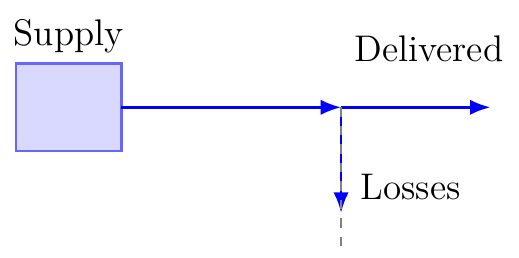
Water Loss Percentage quantifies the fraction of supplied water that does not reach end users.
The indicator is widely used by water utilities and regulatory agencies to evaluate system performance, leakage control, infrastructure condition, and operational efficiency.
Water losses may include physical losses such as leaks and bursts, as well as apparent losses caused by metering inaccuracies or unauthorized consumption.
When to use it
Use this formula when evaluating:
- Municipal water distribution systems
- Leakage reduction programs
- Utility performance benchmarking
- Water conservation projects
- Infrastructure rehabilitation plans
- Non-revenue water assessments
Example
A water utility introduces 150,000 m³/day into its distribution network.
Customers receive 123,000 m³/day.
Data:
Ws = 150,000 m³/day
Wd = 123,000 m³/day
Formula:
WL = (Ws − Wd) / Ws
Substitution:
WL = (150,000 − 123,000) / 150,000
WL = 27,000 / 150,000
Result:
WL = 0.18
Water Loss Percentage = 18%
The distribution system loses approximately 18% of the supplied water.
Applications
- Water utility management
- Leakage monitoring
- Infrastructure planning
- Regulatory reporting
- Sustainability studies
- Water conservation initiatives
Note
This formula provides an overall estimate of water losses but does not distinguish between physical losses and apparent losses. Detailed water audits often separate these categories and may use more sophisticated methodologies recommended by organizations such as the International Water Association (IWA).