
Variables
Description
What is this formula?
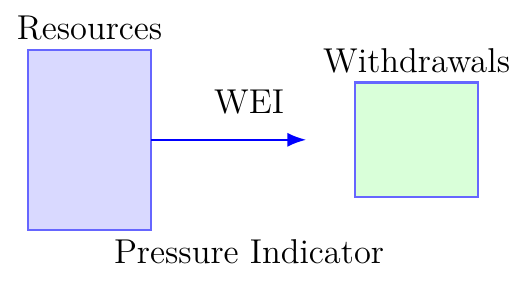
The Water Exploitation Index (WEI) measures the pressure placed on renewable water resources by human water withdrawals.
It is one of the most widely used indicators in water resource management and is commonly employed by governments, environmental agencies, and international organizations to assess water stress.
Higher values indicate greater pressure on available renewable water resources and may signal increasing risks of water scarcity.
When to use it
Use this formula when evaluating:
- Regional water stress
- River basin management
- National water resource planning
- Sustainable development assessments
- Environmental impact studies
- Water security analysis
Example
A river basin withdraws 1.8 billion m³ of water per year.
Its renewable water resources are estimated at 6.0 billion m³ per year.
Data:
Ww = 1.8×10^9 m³/year
Wr = 6.0×10^9 m³/year
Formula:
WEI = Ww / Wr
Substitution:
WEI = 1.8×10^9 / 6.0×10^9
Result:
WEI = 0.30
Water Exploitation Index = 30%
Approximately 30% of the renewable water resources are being withdrawn annually.
Applications
- Water resource planning
- Sustainability assessments
- Climate adaptation studies
- Government policy development
- Environmental management
- International water reporting
Note
The Water Exploitation Index is a simplified indicator and does not account for seasonal variability, water quality constraints, environmental flow requirements, groundwater depletion, or geographic distribution of resources. Different organizations may use slightly different definitions and threshold values when classifying water stress levels.