
Variables
Description
What is this formula?
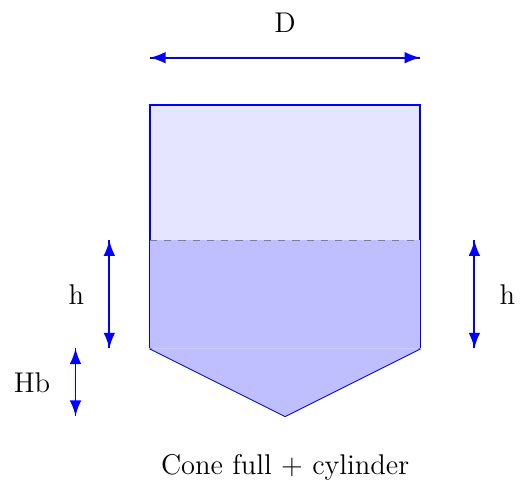
Vertical Tank Liquid Volume Above Conical Bottom calculates the liquid volume in a vertical cylindrical tank after the conical bottom has become completely full.
The total liquid volume is obtained by adding:
- the full conical bottom volume
- the cylindrical liquid volume above the cone
This formula is commonly used in petroleum storage, chemical tanks, water treatment facilities, mining operations, and inventory management systems.
When to use it
Use this formula when:
- the conical bottom is completely full
- the liquid level has risen above the cone
- the measured liquid height is referenced from the top of the cone
This situation occurs during normal operation of most storage tanks.
Example
A tank has:
D = 12.0 m
Hb = 0.30 m
h = 4.50 m
Formula:
V = πD²Hb/12 + πD²h/4
Substitution:
V = π×12²×0.30/12 + π×12²×4.50/4
Result:
V = 11.31 + 508.94
V = 520.25 m³
The tank contains approximately 520.25 m³ of liquid.
Applications
- Petroleum storage tanks
- Custody transfer systems
- Tank calibration tables
- Bulk liquid inventory
- Chemical storage facilities
- Water treatment tanks
Note
This formula assumes that the conical bottom is already completely full.
The variable h represents only the liquid height measured above the top of the conical bottom.
If the liquid level remains inside the cone, the formula:
Liquid Volume in Conical Tank Bottom
should be used instead.
In practical tank gauging systems, operators often use two different calibration regions:
1. Cone region
2. Cylindrical region above the cone
This formula represents the second region.
For high-accuracy custody transfer applications, tank calibration tables generated according to API standards should always take precedence over simplified geometric calculations.