
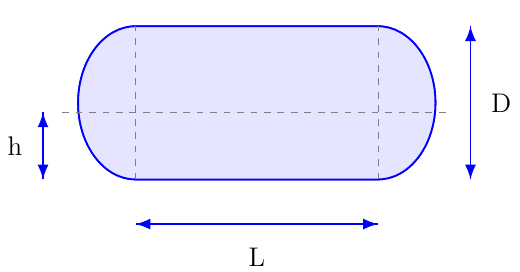
Variables
Description
What is this formula?
Partially Filled Horizontal Tank Volume with Hemispherical Heads calculates the liquid volume inside a horizontal tank that has a cylindrical body and two hemispherical heads.
The formula combines the circular-segment volume of the horizontal cylindrical shell with the spherical-cap volume contributed by the two hemispherical heads.
Because two hemispherical heads together form a complete sphere, the head contribution can be calculated as the liquid volume of a sphere filled to the same height h.
When to use it
Use this formula when the tank is horizontal, has two hemispherical heads, and is only partially filled.
It is especially useful when the liquid level is measured from the bottom of the tank and the user needs the actual inventory volume.
Example
A horizontal tank with hemispherical heads has:
D = 2.0 m
L = 10.0 m
h = 0.80 m
Formula:
V = L × [(D²/4) × acos((D−2h)/D) − ((D/2)−h) × √(Dh−h²)] + πh²(3D−2h)/6
Substitution:
V = 10 × [(2²/4) × acos((2−2×0.8)/2) − ((2/2)−0.8) × √(2×0.8−0.8²)] + π×0.8²×(3×2−2×0.8)/6
Result:
V = 22.94 m³
The partially filled tank contains approximately 22.94 m³ of liquid.
Applications
- LPG tank inventory
- Horizontal pressure vessel gauging
- Cryogenic tank volume estimation
- Chemical storage tanks
- Petroleum process vessels
- Industrial liquid level calculations
Note
This formula assumes a horizontal cylindrical shell with two identical hemispherical heads and a uniform liquid level across the vessel.
It is valid for liquid depths from 0 to D.
The cylindrical section and the hemispherical heads have different geometries, but this formula combines both contributions directly so the user only needs D, L, and h.
For tanks with elliptical, ellipsoidal, torispherical, conical, or flat heads, a different liquid-volume formula is required.