
Variables
Description
What is this formula?
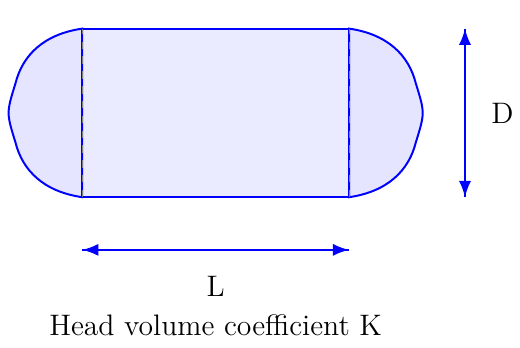
Horizontal Tank Volume with Generic Torispherical Heads calculates the total internal volume of a horizontal cylindrical tank using a geometric coefficient for the combined volume of both torispherical heads.
The cylindrical shell volume is calculated exactly, while the torispherical head contribution is represented by the coefficient K.
This approach is useful when the head geometry does not correspond exactly to a standard ASME F&D approximation, or when a manufacturer provides a specific head volume coefficient.
When to use it
Use this formula when the tank has a cylindrical shell and two torispherical heads, but the head geometry is not necessarily the standard ASME F&D type.
It is useful when the crown radius, knuckle radius, fabrication standard, or manufacturer data leads to a specific head volume coefficient.
Example
A horizontal vessel has:
D = 3.0 m
L = 8.0 m
K = 0.155
Formula:
V = πD²L/4 + KD³
Substitution:
V = π×3²×8/4 + 0.155×3³
V = 56.55 + 4.19
Result:
V = 60.74 m³
The estimated internal volume of the vessel is approximately 60.74 m³.
Applications
- Non-standard torispherical head tanks
- Manufacturer-specific vessel capacity
- Pressure vessel volume estimation
- Process tank design
- Petroleum and chemical vessels
- Industrial inventory calculations
Note
This formula is a parametrized engineering model. The coefficient K represents the combined volume contribution of two torispherical heads and depends on the actual crown radius, knuckle radius, diameter, and fabrication standard.
For a standard ASME F&D torispherical head pair, a commonly used approximation is K = 0.1618. For other torispherical geometries, K should be obtained from manufacturer data, design drawings, technical tables, or detailed geometric calculations.
This formula is useful for capacity estimation, but it should not replace detailed vessel design calculations required by pressure vessel codes.