
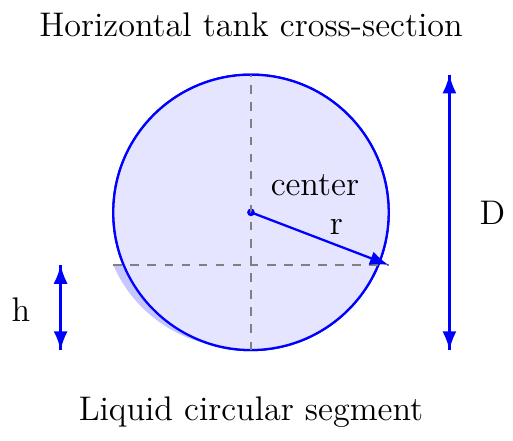
Variables
Description
What is this formula?
Horizontal Tank Liquid Volume calculates the volume of liquid contained in a partially filled horizontal cylindrical tank.
Unlike the full tank volume formula, this equation accounts for the liquid level and uses the exact geometry of a circular segment.
This is one of the most frequently used tank calculations in petroleum, chemical, water treatment, food processing, and industrial storage applications.
When to use it
Use this formula when the tank is horizontal and partially filled.
It is appropriate when determining inventory, custody transfer quantities, operational storage levels, or remaining capacity.
Example
A horizontal tank has:
D = 2.0 m
L = 10.0 m
h = 0.80 m
Formula:
V = L × [(D²/4) × acos((D−2h)/D) − ((D/2)−h) × √(Dh−h²)]
Substitution:
V = 10 × [(2²/4) × acos((2−1.6)/2) − (1−0.8) × √(2×0.8−0.8²)]
Result:
V ≈ 21.46 m³
The tank contains approximately 21.46 m³ of liquid.
Applications
- Petroleum storage tanks
- Fuel inventory calculations
- Chemical storage facilities
- Water treatment plants
- Industrial process tanks
- Custody transfer measurements
Note
This formula is exact for a horizontal cylindrical shell with constant diameter and flat ends. If the tank includes hemispherical, ellipsoidal, torispherical, or other dished heads, the head volumes must be calculated separately and added to the cylindrical liquid volume. This distinction is especially important for custody transfer and inventory calculations in the petroleum industry.