
Variables
Description
What is this formula?
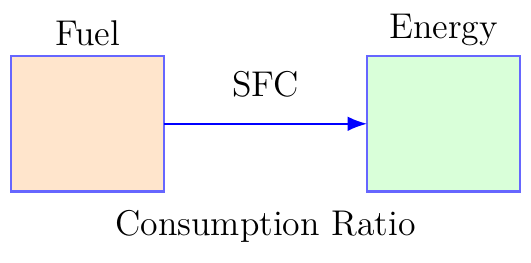
Specific Fuel Consumption (SFC) measures the amount of fuel required to produce a unit of useful energy output.
It is one of the most common indicators used to evaluate the performance of power plants, engines, turbines, generators, and industrial energy systems.
Lower SFC values indicate better fuel utilization because less fuel is needed to produce the same amount of energy.
When to use it
Use this formula when evaluating:
- Thermal power plants
- Gas turbines
- Diesel generators
- Internal combustion engines
- Industrial boilers
- Energy conversion systems
Example
A power plant consumes 450,000 kg of coal during a month and produces 1,500 MWh of electricity.
Data:
mf = 450,000 kg
Eo = 1,500 MWh
Formula:
SFC = mf / Eo
Substitution:
SFC = 450,000 / 1,500
Result:
SFC = 300 kg/MWh
The plant requires 300 kg of coal to generate each MWh of electricity.
Applications
- Power plant benchmarking
- Fuel cost estimation
- Energy efficiency studies
- Operational optimization
- Equipment performance monitoring
- Sustainability assessments
Note
Specific Fuel Consumption depends on fuel quality, equipment condition, operating load, ambient conditions, and technology type. Different industries may express SFC using alternative units such as kg/kWh, g/kWh, kg/MWh, or lb/MWh. Comparisons should only be made when equivalent units and operating conditions are used.