
Variables
Description
What is this formula?
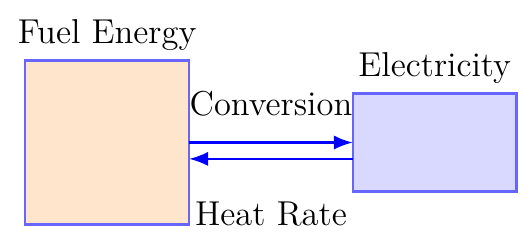
Heat Rate (HR) measures the amount of fuel energy required to generate a unit of electrical energy.
It is one of the most important performance indicators for thermal power plants and is widely used in energy engineering, utility operations, and power plant optimization.
A lower heat rate indicates better plant performance because less fuel is required to produce the same amount of electricity.
When to use it
Use this formula when evaluating:
- Coal-fired power plants
- Natural gas power plants
- Combined-cycle facilities
- Biomass power stations
- Thermal generation efficiency
- Fuel consumption analysis
Example
A natural gas power plant consumes fuel containing 7,200,000 MJ of thermal energy and produces 1,000 MWh of electricity.
Data:
Ef = 7,200,000 MJ
Ee = 1,000 MWh
Formula:
HR = Ef / Ee
Substitution:
HR = 7,200,000 / 1,000
Result:
HR = 7,200 MJ/MWh
The plant requires 7,200 MJ of fuel energy to generate each MWh of electricity.
Applications
- Thermal power plant performance
- Utility benchmarking
- Fuel cost estimation
- Energy audits
- Plant optimization studies
- Generation planning
Note
Heat Rate is an operational performance indicator and its value depends on technology, operating conditions, equipment age, fuel quality, ambient temperature, and plant load. Different industries may express heat rate using different unit systems, such as MJ/MWh, kJ/kWh, or Btu/kWh. Lower values generally indicate higher energy conversion efficiency.