
Variables
Description
What is this formula?
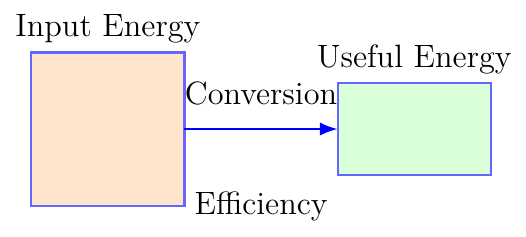
Energy Conversion Efficiency measures the fraction of input energy that is successfully converted into useful output energy.
It is one of the most fundamental performance indicators in energy engineering and is applicable to power plants, engines, turbines, solar systems, batteries, fuel cells, and industrial processes.
An efficiency of 1.0 (100%) would represent perfect conversion, although real systems always experience losses.
When to use it
Use this formula when evaluating:
- Thermal power plants
- Gas turbines
- Steam turbines
- Internal combustion engines
- Solar energy systems
- Fuel cells
- Industrial energy systems
Example
A power generation system receives 1,000 MJ of fuel energy and delivers 420 MJ of useful electrical energy.
Data:
Ei = 1,000 MJ
Eo = 420 MJ
Formula:
η = Eo / Ei
Substitution:
η = 420 / 1,000
Result:
η = 0.42
Efficiency = 42%
The system converts 42% of the supplied energy into useful output.
Applications
- Power plant performance evaluation
- Energy audits
- Equipment benchmarking
- Renewable energy analysis
- Industrial process optimization
- Sustainability studies
Note
Energy Conversion Efficiency is a general performance indicator and its value depends on technology, operating conditions, maintenance, fuel quality, environmental factors, and measurement boundaries. Different industries may define useful output energy differently, so efficiencies should only be compared when calculated using consistent methodologies.