
Variables
Description
What is this formula?
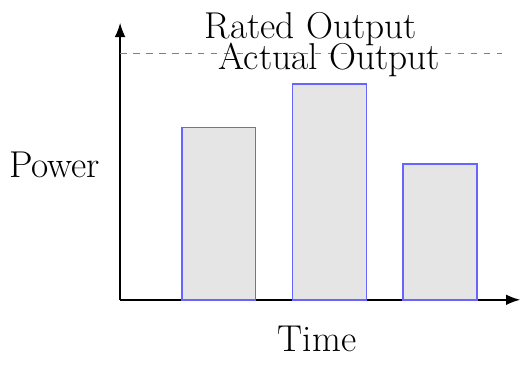
The Capacity Factor (CF) measures how effectively a power generation facility utilizes its installed capacity over a given period.
It compares the actual energy produced with the maximum energy that could have been generated if the plant operated continuously at full rated capacity.
Capacity factor is one of the most important performance indicators in power generation and renewable energy analysis.
When to use it
Use this formula when evaluating:
- Wind farms
- Solar power plants
- Hydroelectric facilities
- Thermal power stations
- Nuclear power plants
- Energy production performance
Example
A wind farm has an installed capacity of 100 MW.
During one year it generates 262,800 MWh.
Data:
Ea = 262,800 MWh
Pr = 100 MW
t = 8,760 h
Formula:
CF = Ea / (Pr × t)
Substitution:
CF = 262,800 / (100 × 8,760)
CF = 262,800 / 876,000
Result:
CF = 0.30
Capacity Factor = 30%
The wind farm produced 30% of its theoretical maximum annual energy output.
Applications
- Renewable energy assessment
- Power plant benchmarking
- Energy project feasibility studies
- Utility performance monitoring
- Grid planning
- Investment analysis
Note
Capacity Factor is an operational performance indicator rather than an efficiency measure. A low capacity factor does not necessarily indicate poor performance. Technologies such as solar and wind power are inherently limited by resource availability, while thermal and nuclear plants may be limited by maintenance schedules, dispatch requirements, fuel availability, or regulatory constraints.