
Variables
Description
What is this formula?
Annual Energy Production (AEP) calculates the total amount of energy generated during a year based on the average power output and operating time.
It is one of the most widely used metrics in power generation, renewable energy projects, and energy resource planning.
AEP is frequently used to estimate revenue, evaluate project feasibility, compare technologies, and determine long-term energy supply capabilities.
When to use it
Use this formula when evaluating:
- Wind farms
- Solar power plants
- Hydroelectric facilities
- Thermal power plants
- Energy production forecasts
- Utility planning studies
Example
A wind farm delivers an average power output of 25 MW throughout the year.
Data:
Pa = 25 MW
t = 8,760 h
Formula:
AEP = Pa × t
Substitution:
AEP = 25 × 8,760
Result:
AEP = 219,000 MWh/year
The wind farm is expected to generate approximately 219,000 MWh of electricity per year.
Applications
- Renewable energy project development
- Power generation forecasting
- Revenue estimation
- Grid planning
- Resource assessment
- Investment analysis
Note
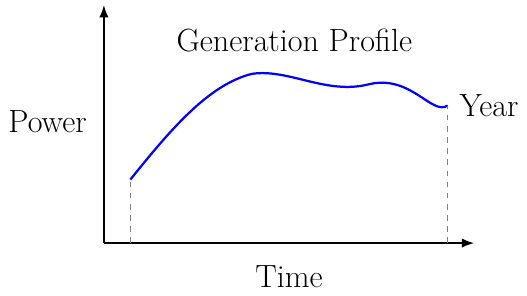
This formula assumes that the average power output remains representative over the entire operating period. In real projects, production varies due to weather conditions, maintenance outages, equipment availability, grid curtailment, seasonal effects, and operational constraints. More detailed studies often use hourly or sub-hourly production profiles to estimate annual energy generation.