
Variables
Description
What is this formula?
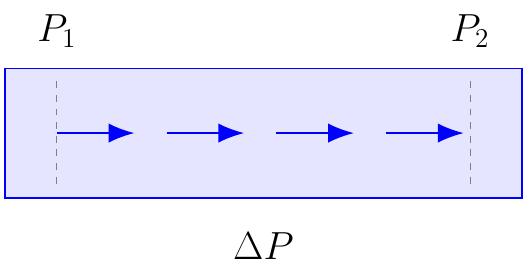
Mine Ventilation Pressure Loss calculates the pressure drop required to move air through a mine airway.
It is one of the most important equations in mine ventilation engineering and is based on Atkinson's ventilation law. The formula relates pressure loss to airway resistance and airflow quantity.
Because pressure loss increases with the square of airflow, increasing ventilation flow often requires significantly more fan pressure.
When to use it
Use this formula when:
- Designing mine ventilation networks.
- Estimating fan pressure requirements.
- Evaluating airway resistance.
- Performing ventilation surveys.
- Optimizing mine ventilation systems.
Example
A mine airway has a resistance of 0.08 Pa·s²/m⁶ and carries 30 m³/s of airflow.
Data:
R = 0.08 Pa·s²/m⁶
Q = 30 m³/s
Formula:
ΔP = RQ²
Substitution:
ΔP = 0.08 × 30²
ΔP = 0.08 × 900
Result:
ΔP = 72 Pa
The airway produces a ventilation pressure loss of 72 Pa.
Applications
- Underground mine ventilation
- Ventilation network analysis
- Main fan selection
- Booster fan design
- Ventilation optimization
- Energy consumption studies
Note
This equation is an empirical engineering relationship widely used in mine ventilation. The airway resistance depends on airway dimensions, roughness, support systems, obstructions, regulators, doors, and other ventilation controls. Actual mine ventilation networks contain multiple branches whose combined resistance must be analyzed using network methods.