
Variables
Description
What is this formula?
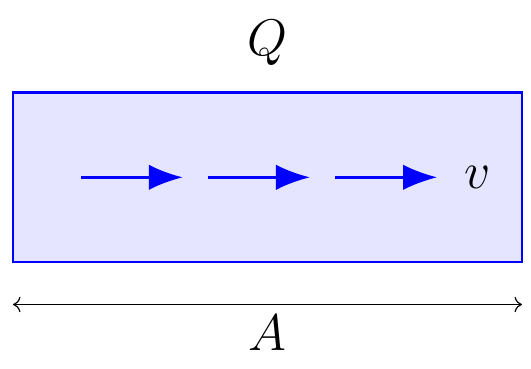
Airflow Velocity calculates the average speed of air moving through a mine airway, tunnel, shaft, or ventilation duct.
It is one of the fundamental equations of mine ventilation and is derived directly from the continuity relationship between volumetric airflow and cross-sectional area.
When to use it
Use this formula when:
- Measuring mine ventilation performance.
- Designing ventilation circuits.
- Evaluating airflow distribution.
- Verifying regulatory ventilation requirements.
- Sizing ventilation raises, drifts, and shafts.
Example
A mine drift carries an airflow of 45 m³/s and has a cross-sectional area of 12 m².
Data:
Q = 45 m³/s
A = 12 m²
Formula:
v = Q / A
Substitution:
v = 45 / 12
Result:
v = 3.75 m/s
The average air velocity in the drift is 3.75 m/s.
Applications
- Underground mine ventilation
- Ventilation surveys
- Airflow monitoring
- Ventilation system design
- Fan performance evaluation
- Occupational health and safety
Air velocity is commonly measured using vane anemometers, hot-wire anemometers, or ultrasonic airflow instruments.