
Variables
Description
What is this formula?
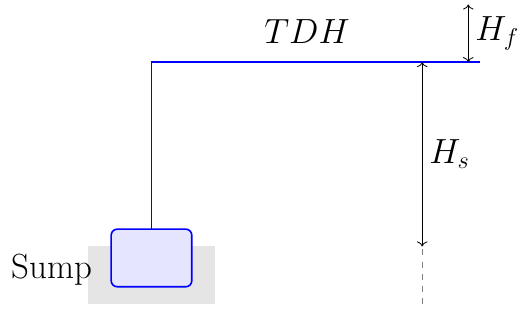
Total Dynamic Head (TDH) represents the total head that a pump must overcome to move water through a dewatering system.
It combines the static head, which is the elevation difference between the water source and discharge point, with the friction losses that occur in pipes, valves, fittings, and other hydraulic components.
TDH is one of the most important parameters for pump selection and dewatering system design.
When to use it
Use this formula when:
- Selecting mine dewatering pumps.
- Designing drainage systems.
- Estimating pumping power requirements.
- Evaluating pipeline performance.
- Analyzing water management systems.
Example
A mine sump is located 65 m below the discharge point. The piping system introduces friction losses equivalent to 12 m of head.
Data:
Hs = 65 m
Hf = 12 m
Formula:
TDH = Hs + Hf
Substitution:
TDH = 65 + 12
Result:
TDH = 77 m
The pump must overcome a total dynamic head of 77 m.
Applications
- Underground mine dewatering
- Open-pit mine drainage
- Pump selection
- Pipeline design
- Water management systems
- Energy consumption calculations
Note
This formula represents the basic definition of total dynamic head. Real pumping systems may include additional components such as velocity head, pressure head differences, control valves, aging pipelines, and variable operating conditions. Detailed hydraulic analyses often include these effects when high accuracy is required.