
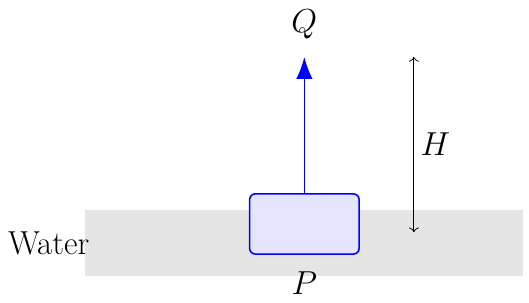
Variables
Description
What is this formula?
Pump Power calculates the power required to lift and transport water through a mine dewatering system.
It relates the flow rate, pumping head, fluid density, and pump efficiency to determine the mechanical power that must be supplied by the pump.
This is one of the most important calculations in mine dewatering design because pump power directly affects equipment selection and energy consumption.
When to use it
Use this formula when:
- Selecting dewatering pumps.
- Estimating electrical power requirements.
- Designing mine drainage systems.
- Evaluating pumping costs.
- Comparing alternative pumping arrangements.
Example
A mine dewatering system pumps water at a rate of 0.05 m³/s through a total dynamic head of 80 m. The pump efficiency is 75%.
Data:
ρ = 1000 kg/m³
g = 9.81 m/s²
Q = 0.05 m³/s
H = 80 m
η = 0.75
Formula:
P = (ρgQH)/η
Substitution:
P = (1000 × 9.81 × 0.05 × 80)/0.75
Result:
P = 52,320 W
P ≈ 52.3 kW
The pump requires approximately 52.3 kW of input power.
Applications
- Mine dewatering
- Pump selection
- Drainage system design
- Energy consumption analysis
- Water management systems
- Capital and operating cost estimation
Note
This formula calculates the theoretical power requirement based on hydraulic conditions. Actual installed motor power is often higher to provide safety margins and account for mechanical losses, wear, variable operating conditions, and future increases in pumping demand.