
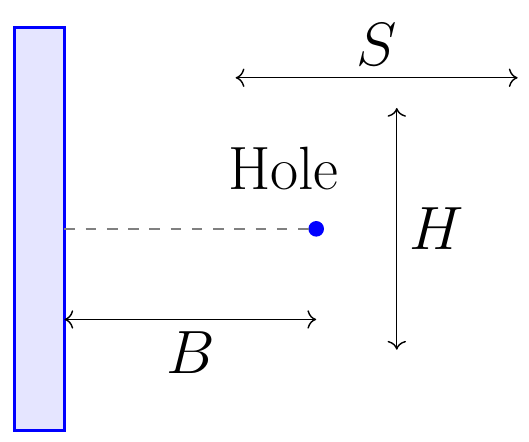
Variables
Description
What is this formula?
Blast Volume per Hole estimates the volume of rock assigned to a single blast hole within a drilling pattern. It is one of the most commonly used calculations in blast design because it links drilling geometry with production volume.
The formula assumes that each hole is responsible for fragmenting a rectangular prism of rock defined by the burden, spacing, and bench height.
When to use it
Use this formula when:
- Estimating blast production.
- Calculating powder factor.
- Designing drilling patterns.
- Estimating explosive requirements.
- Planning mine production schedules.
Example
A bench blast uses the following geometry:
B = 5.0 m
S = 6.5 m
H = 12 m
Formula:
V = B × S × H
Substitution:
V = 5.0 × 6.5 × 12
Result:
V = 390 m³
Each blast hole is expected to break approximately 390 cubic meters of rock.
Applications
- Surface mining
- Quarry operations
- Production blast design
- Explosive consumption calculations
- Powder factor calculations
- Mine planning
Note
This formula provides a geometric estimate of the rock volume associated with each hole. Actual blasted volume may differ due to hole deviation, irregular bench geometry, geological discontinuities, toe formation, backbreak, and variations in burden or spacing. It is primarily used for preliminary blast design and production calculations.