
Variables
Description
What is this formula?
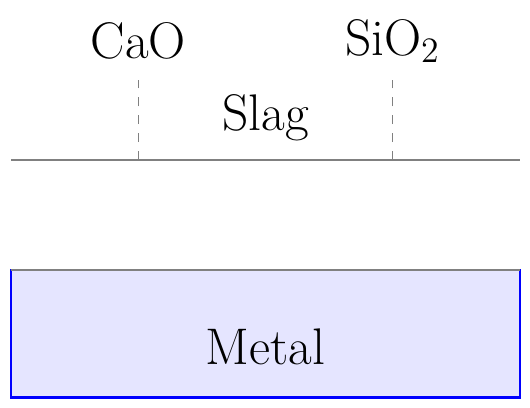
The Slag Basicity Ratio measures the relative amount of basic oxide to acidic oxide in a metallurgical slag.
It is one of the most important parameters in pyrometallurgy because it influences sulfur removal, phosphorus removal, viscosity, refractory wear, melting behavior, and metal recovery.
A higher basicity generally indicates a more basic slag capable of absorbing acidic impurities.
When to use it
Use this formula when designing or controlling slags in steelmaking, ironmaking, ferroalloy production, copper smelting, and other high-temperature metallurgical processes.
It is commonly used for process optimization and slag quality control.
Example
A slag contains:
CaO = 42 %
SiO2 = 28 %
Formula:
B=CaO/SiO2
Substitution:
B=42/28
B=1.50
Result:
The slag basicity ratio is 1.50, indicating a moderately basic slag.
Applications
- Steelmaking
- Blast furnace operation
- Electric arc furnaces
- Copper smelting
- Ferroalloy production
- Slag design and control
Note
This is an empirical metallurgical index rather than a universal physical law. Numerous basicity definitions exist in industry, including binary, ternary, and modified basicity ratios that incorporate MgO, Al2O3, FeO, and other oxides. The CaO/SiO2 ratio is the most widely used and simplest basicity indicator.