
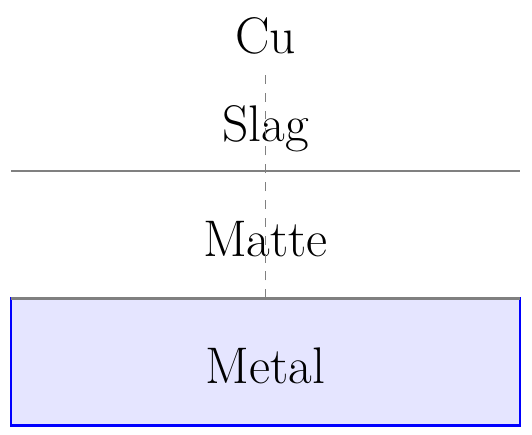
Variables
Description
What is this formula?
Matte Grade calculates the concentration of valuable metal contained in a metallurgical matte.
In copper, nickel, and other sulfide smelting operations, matte grade is one of the most important process control parameters because it reflects the distribution of valuable metals between matte, slag, and gas phases.
Higher matte grades generally indicate a more concentrated intermediate product.
When to use it
Use this formula when evaluating smelting furnace performance, converter operation, matte quality, and metallurgical recovery in sulfide metallurgy.
It is widely used in copper and nickel smelters.
Example
A copper matte contains:
Copper mass = 5200 kg
Total matte mass = 8000 kg
Formula:
MG=(mCu/mMatte)*100
Substitution:
MG=(5200/8000)*100
MG=65 %
Result:
The matte contains 65 % copper by mass.
Applications
- Copper smelting
- Nickel smelting
- Flash smelting operations
- Converter control
- Matte quality monitoring
- Metallurgical accounting
Note
This is an industrial metallurgical indicator rather than a fundamental physical law. Depending on the metal being processed, matte grade may be reported as copper grade, nickel grade, or total valuable metal content. Alternative reporting conventions exist among different smelters and metallurgical operations.