
Variables
Description
What is this formula?
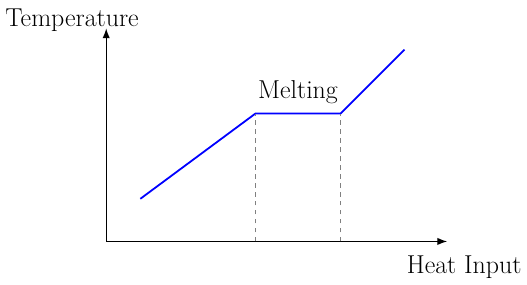
The Heat Required for Metal Melting formula calculates the total thermal energy required to heat a metal from its initial temperature to its melting temperature and then completely melt it.
The equation combines sensible heating and latent heat of fusion into a single energy balance.
It is one of the most important calculations in pyrometallurgy, foundry operations, casting, metal refining, and furnace design.
When to use it
Use this formula when estimating furnace energy requirements, calculating melting costs, sizing heating equipment, or evaluating thermal efficiency in metallurgical processes.
Example
A furnace must melt:
m = 500 kg
Cp = 500 J/(kg·K)
Ti = 300 K
Tm = 1800 K
Lf = 270000 J/kg
Formula:
Q=m[Cp(Tm−Ti)+Lf]
Substitution:
Q=500[(500×(1800−300))+270000]
Q=510000000 J
Result:
The furnace must supply approximately 5.10×10^8 J of heat.
Applications
- Steelmaking
- Aluminum melting
- Copper smelting
- Foundry operations
- Furnace design
- Energy consumption estimation
Note
This formula assumes uniform heating and complete melting without heat losses. Real furnaces experience thermal losses through walls, exhaust gases, radiation, and incomplete heat transfer. Consequently, actual industrial energy requirements are typically higher than the theoretical value calculated by this equation.