
Variables
Description
What is this formula?
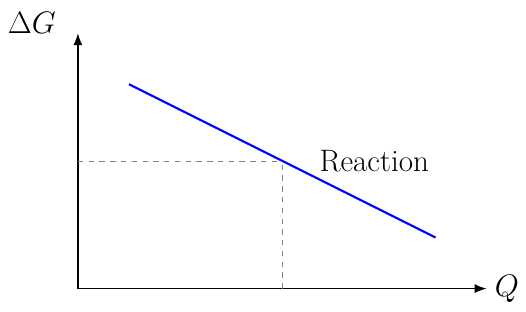
Oxide Reduction Free Energy calculates the Gibbs free energy of a reduction reaction under actual process conditions.
In extractive metallurgy, this equation is used to determine whether a metal oxide can be reduced under a given gas composition, temperature, and operating environment.
A negative value of ΔG indicates that the reduction reaction is thermodynamically favorable.
When to use it
Use this formula when evaluating reduction reactions involving iron oxides, copper oxides, nickel oxides, zinc oxides, and other metallurgical systems.
It is commonly applied in conjunction with equilibrium constants, Ellingham diagrams, and gas atmosphere calculations.
Example
For a reduction reaction:
ΔG° = -180000 J/mol
R = 8.314 J/(mol·K)
T = 1200 K
K = 10
Formula:
ΔG=ΔG°+RTln(K)
Substitution:
ΔG=-180000+(8.314×1200×ln(10))
ΔG=-157026 J/mol
Result:
The reaction remains thermodynamically favorable because ΔG is negative.
Applications
- Reduction process design
- Furnace atmosphere analysis
- Smelting operations
- Steelmaking
- Copper extraction
- Thermodynamic process evaluation
Note
This equation is an exact thermodynamic relationship. However, practical metallurgical systems may depart from equilibrium due to kinetic limitations, incomplete mixing, mass transfer effects, and non-ideal activities. Consequently, a negative ΔG indicates thermodynamic feasibility but does not guarantee that the reaction will proceed at an economically useful rate.