
Variables
Description
What is this formula?
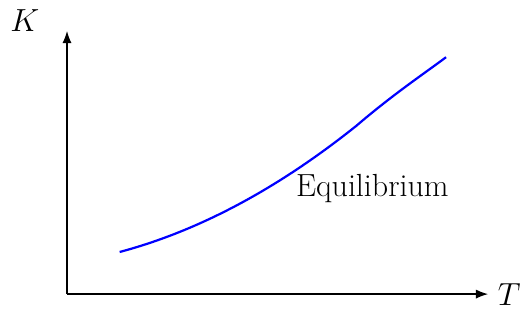
The Metallurgical Reaction Equilibrium Constant relates the equilibrium constant of a reaction to its standard Gibbs free energy change.
It is one of the most important equations in metallurgical thermodynamics because it quantifies the tendency of a reaction to proceed toward products or reactants at equilibrium.
Large values of K indicate that products are strongly favored, whereas small values indicate that reactants are favored.
When to use it
Use this formula when evaluating oxidation, reduction, smelting, refining, roasting, and slag-metal reactions.
It is commonly used together with Ellingham diagrams and Gibbs free energy calculations.
Example
For a reaction:
ΔG° = -120000 J/mol
R = 8.314 J/(mol·K)
T = 1200 K
Formula:
K=exp(-ΔG°/(RT))
Substitution:
K=exp(-(-120000)/(8.314×1200))
K≈1.67×10^5
Result:
The large equilibrium constant indicates that the reaction strongly favors product formation.
Applications
- Reduction reaction analysis
- Oxidation equilibrium calculations
- Smelting process design
- Refining operations
- Slag-metal equilibrium studies
- Metallurgical thermodynamic modeling
Note
This equation is an exact thermodynamic relationship under equilibrium conditions. Real metallurgical systems may deviate from equilibrium because of kinetic limitations, mass-transfer resistance, incomplete mixing, or non-ideal activities. Therefore, the calculated value represents the thermodynamic equilibrium state rather than the actual operating condition.