
Variables
Description
What is this formula?
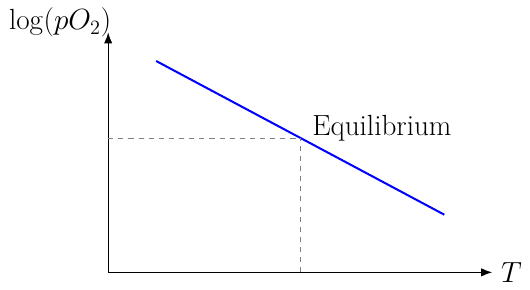
The Equilibrium Oxygen Partial Pressure formula calculates the oxygen partial pressure corresponding to thermodynamic equilibrium between a metal and its oxide.
It is extensively used in extractive metallurgy to determine oxidation and reduction conditions in furnaces, converters, reactors, and refining processes.
A lower equilibrium oxygen partial pressure indicates that the oxide is more stable and more difficult to reduce.
When to use it
Use this formula when evaluating oxide stability, reduction feasibility, oxygen potential, or equilibrium gas atmospheres in metallurgical processes.
It is commonly applied together with Ellingham diagrams and Gibbs free energy calculations.
Example
For a reaction:
ΔG° = -250000 J/mol
R = 8.314 J/(mol·K)
T = 1200 K
Formula:
pO2=exp((2ΔG°)/(RT))
Substitution:
pO2=exp((2×(-250000))/(8.314×1200))
pO2≈1.7×10^-22 atm
Result:
The equilibrium oxygen partial pressure is extremely low, indicating a highly stable oxide.
Applications
- Oxide stability analysis
- Reduction process design
- Smelting operations
- Steelmaking
- Copper metallurgy
- Oxygen potential calculations
Note
This equation is derived from equilibrium thermodynamics and assumes ideal behavior of gases and pure condensed phases. Real metallurgical systems may exhibit deviations due to non-ideal activities, gas mixtures, pressure effects, and kinetic limitations. Alternative formulations may include activity corrections for greater accuracy.