
Variables
Description
What is this formula?
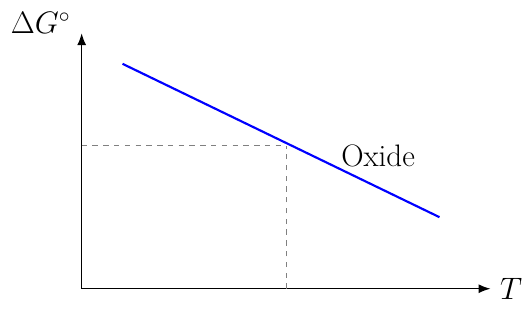
The Ellingham Free Energy Line calculates the standard Gibbs free energy change of an oxidation or reduction reaction as a function of temperature.
It forms the basis of the Ellingham diagram, one of the most important tools in extractive metallurgy and pyrometallurgy for predicting the stability of metal oxides and the feasibility of reduction reactions.
When to use it
Use this formula when evaluating whether a metal oxide can be reduced by carbon, carbon monoxide, hydrogen, or another reducing agent at a given temperature.
It is widely used in steelmaking, copper smelting, iron production, and metallurgical process design.
Example
For a reaction:
ΔH° = -500000 J/mol
ΔS° = -120 J/(mol·K)
T = 1500 K
Formula:
ΔG°=ΔH°−TΔS°
Substitution:
ΔG°=-500000-(1500×(-120))
ΔG°=-320000 J/mol
Result:
The reaction remains thermodynamically favorable because the Gibbs free energy change is negative.
Applications
- Ellingham diagram construction
- Oxide stability analysis
- Metallurgical reduction processes
- Iron and steel production
- Smelting operations
- Thermodynamic process design
Note
This equation represents a thermodynamic model under standard-state conditions. Real metallurgical systems may deviate from ideal behavior due to non-standard activities, gas compositions, pressure effects, and kinetic limitations. Ellingham diagrams derived from this relationship are therefore used primarily as equilibrium guides.