
Variables
Description
What is this formula?
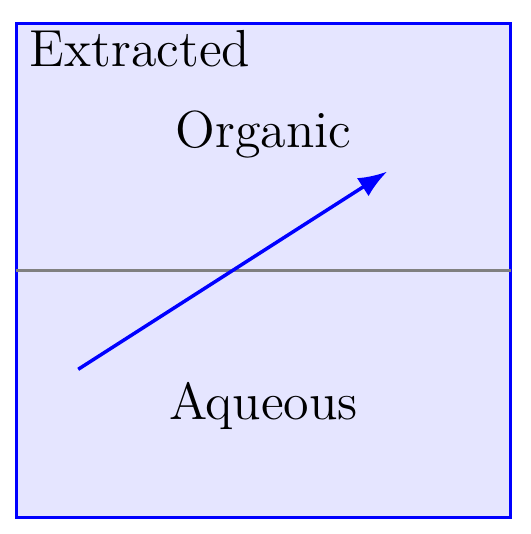
The Solvent Extraction Percentage calculates the fraction of dissolved metal transferred from the aqueous phase to the organic phase during a single equilibrium extraction stage.
It converts the distribution ratio into a more intuitive extraction efficiency expressed as a percentage.
Higher values indicate more effective metal transfer into the organic phase.
When to use it
Use this formula when evaluating solvent extraction performance, comparing extractants, designing extraction stages, or estimating metal recovery in hydrometallurgical circuits.
It is widely used in copper SX-EW, uranium extraction, cobalt recovery, and rare earth processing.
Example
A solvent extraction test gives:
Distribution ratio = 4
Formula:
E=(D/(D+1))*100
Substitution:
E=(4/(4+1))*100
E=80 %
Result:
Eighty percent of the dissolved metal is transferred to the organic phase in a single extraction stage.
Applications
- Copper SX-EW plants
- Uranium recovery
- Cobalt and nickel extraction
- Rare earth separation
- Solvent extraction circuit design
- Process optimization
Note
This equation assumes equilibrium conditions and equal volumes of aqueous and organic phases. In industrial practice, extraction efficiency may differ because of phase ratio effects, incomplete mixing, mass-transfer limitations, and non-equilibrium operation. More complex expressions are commonly used when phase volumes are unequal.