
Variables
Description
What is this formula?
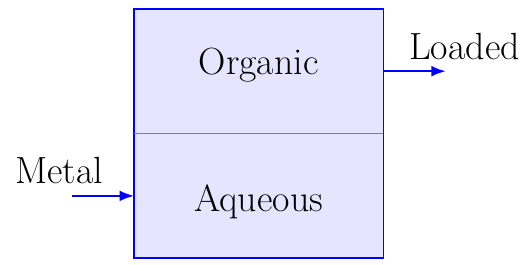
The Solvent Extraction Distribution Ratio calculates how a dissolved metal is distributed between the organic and aqueous phases during a solvent extraction process.
It is one of the most important parameters in hydrometallurgy because it quantifies the extraction strength of the organic reagent toward a specific metal.
Higher values of D indicate that the metal preferentially transfers into the organic phase.
When to use it
Use this formula when designing, evaluating, or optimizing solvent extraction circuits for copper, uranium, nickel, cobalt, rare earth elements, and other metals.
It is commonly used in mixer-settlers, extraction columns, and hydrometallurgical process simulations.
Example
A solvent extraction test produces:
Metal concentration in organic phase = 8.0 g/L
Metal concentration in aqueous phase = 2.0 g/L
Formula:
D=Corg/Caq
Substitution:
D=8.0/2.0
D=4.0
Result:
The metal concentration in the organic phase is four times greater than in the aqueous phase.
Applications
- Copper SX-EW operations
- Uranium extraction
- Nickel and cobalt recovery
- Rare earth processing
- Hydrometallurgical circuit design
- Solvent extraction optimization
Note
This is an empirical process-performance parameter rather than a fundamental physical law. The distribution ratio depends on extractant chemistry, pH, temperature, phase composition, ionic strength, and equilibrium conditions. Distribution ratios are often measured experimentally and may vary significantly between operating conditions.