
Variables
Description
What is this formula?
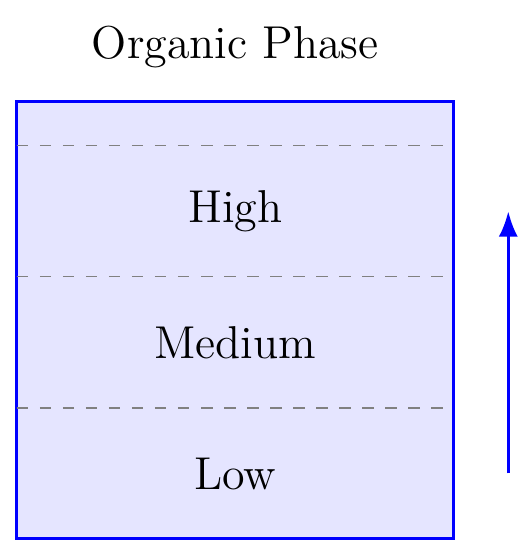
Metal Loading Capacity calculates the amount of metal that has been absorbed by an organic solvent during a solvent extraction process.
It represents the increase in metal concentration between the fresh organic phase and the loaded organic phase after contact with the aqueous solution.
This parameter is widely used to evaluate solvent utilization and extraction performance.
When to use it
Use this formula when monitoring solvent extraction circuits, evaluating extractant performance, estimating solvent inventory requirements, or optimizing hydrometallurgical recovery systems.
It is commonly applied in copper SX-EW, uranium extraction, cobalt recovery, and rare earth processing.
Example
A solvent extraction circuit operates with:
Loaded organic concentration = 18 g/L
Fresh organic concentration = 2 g/L
Formula:
LC=Cloaded−Cfresh
Substitution:
LC=18−2
LC=16 g/L
Result:
The organic phase has loaded 16 g/L of metal during extraction.
Applications
- Copper SX-EW operations
- Uranium extraction
- Cobalt and nickel recovery
- Rare earth processing
- Solvent inventory management
- Process optimization
Note
This is an operational process parameter rather than a fundamental physical law. Metal loading capacity depends on extractant chemistry, phase ratio, equilibrium conditions, temperature, pH, and metal concentration. Different solvent extraction systems may have significantly different loading capacities even when processing the same metal.