
Variables
Description
What is this formula?
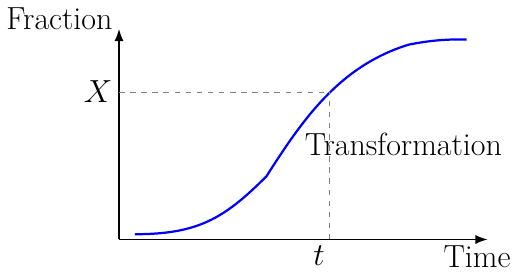
The JMAK (Johnson-Mehl-Avrami-Kolmogorov) Equation predicts the fraction of material transformed during phase transformations controlled by nucleation and growth processes. It is one of the most widely used models in materials science for describing transformation kinetics.
When to use it
Use this formula when analyzing recrystallization, precipitation hardening, crystallization, solid-state phase transformations, or other processes where new phases nucleate and grow over time.
Example
A steel heat treatment process has:
k = 0.005 s^-n
n = 2
t = 20 s
Formula:
X = 1 - e^(-(k*t^n))
Substitution:
X = 1 - e^(-(0.005*20^2))
X = 1 - e^(-2)
Result:
X = 0.865
Approximately 86.5% of the transformation has occurred.
Applications
- Heat treatment analysis
- Recrystallization kinetics
- Precipitation hardening
- Crystallization studies
- Metallurgical process design
- Materials science research
Note
The JMAK equation is an empirical kinetic model. The parameters k and n depend on temperature, material composition, nucleation mechanisms, and growth behavior. Real materials may deviate from JMAK predictions due to impingement effects, heterogeneous nucleation, diffusion limitations, or changing transformation mechanisms.