
Variables
Description
What is this formula?
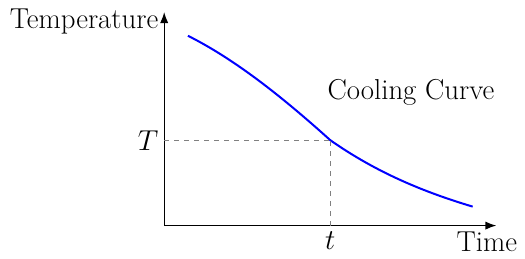
The Continuous Cooling Transformation Parameter, commonly expressed as cooling rate, quantifies how rapidly a material cools during a thermal process. Cooling rate strongly influences phase transformations, microstructure formation, hardness, strength, and toughness.
When to use it
Use this formula when analyzing heat treatment operations such as quenching, normalizing, annealing, welding, casting, or any process where cooling history affects final material properties.
Example
A steel component cools from 900 °C to 300 °C in 60 seconds.
Data:
T1 = 900 °C
T2 = 300 °C
t = 60 s
Formula:
CCR = (T1 - T2) / t
Substitution:
CCR = (900 - 300) / 60
Result:
CCR = 10 °C/s
The average cooling rate is 10 °C/s.
Applications
- Heat treatment design
- Continuous Cooling Transformation (CCT) analysis
- Welding metallurgy
- Quenching process control
- Casting simulations
- Microstructure prediction
Note
This equation provides an average cooling rate over a temperature interval. Actual cooling curves are often non-linear, and instantaneous cooling rates may vary significantly during processing. Detailed CCT analysis frequently requires full cooling curves rather than a single average value.