
Variables
Description
What is this formula?
The Paris Fatigue Crack Growth Law predicts the rate at which a fatigue crack grows under cyclic loading. It is one of the most widely used relationships in fracture mechanics and fatigue analysis.
When to use it
Use this formula when estimating crack propagation rates in components subjected to repeated loading, such as aircraft structures, bridges, pressure vessels, pipelines, rotating machinery, and mechanical equipment.
Example
A material has:
C = 2×10^-12
m = 3
dK = 20 MPa·√m
Formula:
dadN = C*(dK^m)
Substitution:
dadN = 2×10^-12 × 20^3
dadN = 2×10^-12 × 8000
Result:
dadN = 1.6×10^-8 m/cycle
The crack grows approximately 1.6×10^-8 meters during each load cycle.
Applications
- Fatigue life prediction
- Aircraft structural analysis
- Pipeline integrity assessment
- Pressure vessel inspection planning
- Rotating equipment maintenance
- Damage tolerance analysis
Note
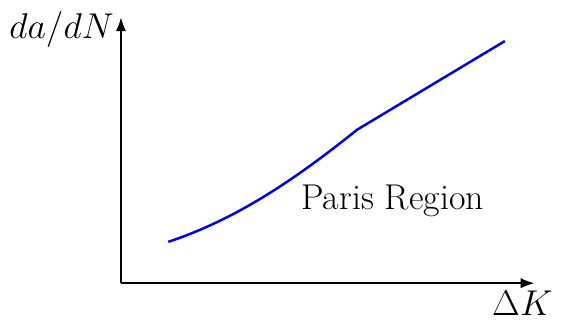
The Paris Law is an empirical relationship valid only within the stable crack growth region of a fatigue crack growth curve. It does not accurately describe crack initiation, near-threshold behavior, or rapid fracture near final failure. The constants C and m must be determined experimentally for each material and environment.