
Variables
Description
What is this formula?
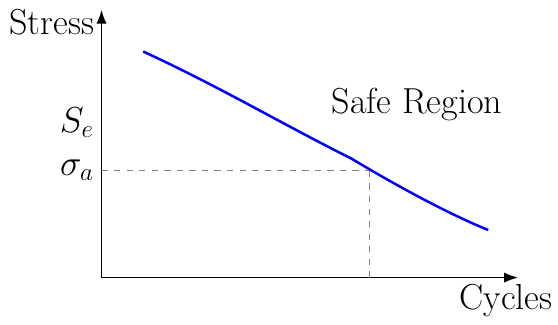
The Fatigue Safety Factor compares the fatigue endurance limit of a material with the actual alternating stress experienced by a component. It provides a simple measure of how safely a design operates under cyclic loading conditions.
When to use it
Use this formula during fatigue design, equipment evaluation, rotating machinery analysis, structural assessments, and preventive maintenance studies where repeated loading is present.
Example
A steel shaft has:
Se = 250 MPa
sigmaa = 100 MPa
Formula:
nf = Se / sigmaa
Substitution:
nf = 250 / 100
Result:
nf = 2.5
The shaft operates with a fatigue safety factor of 2.5, indicating that the alternating stress is well below the endurance limit.
Applications
- Mechanical design
- Rotating shafts
- Gears and bearings
- Automotive components
- Aerospace structures
- Fatigue risk assessment
Note
This equation represents the simplest fatigue safety factor approach and is most appropriate for fully reversed loading and materials exhibiting a well-defined endurance limit. Real engineering designs often apply correction factors for surface finish, size, reliability, temperature, stress concentration, mean stress effects, and loading type. More advanced criteria such as Goodman, Gerber, or Soderberg may be required for accurate fatigue design.