
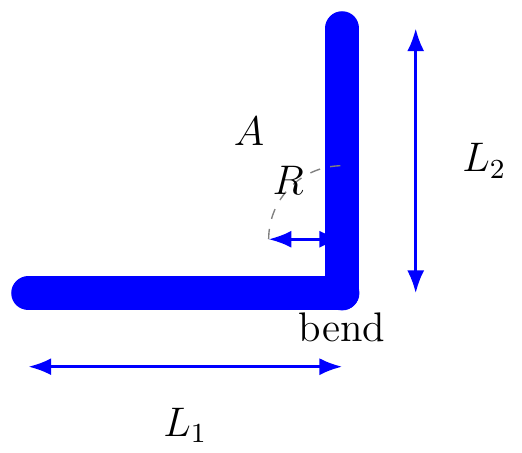
Variables
Description
What is this formula?
Sheet Metal Bend Allowance calculates the length of material consumed in the bend region of a sheet metal part. It is a fundamental parameter used to determine the correct flat pattern dimensions before bending operations.
When to use it
Use this formula when designing sheet metal parts, creating flat patterns, programming CNC press brakes, estimating material requirements, or reducing dimensional errors in fabrication.
Example
A steel sheet with a thickness of 2 mm is bent through an angle of 90°. The inside bend radius is 3 mm and the selected K-factor is 0.33.
Data:
A = 90°
R = 3 mm
K = 0.33
T = 2 mm
Formula:
BA = (π × A × (R + K × T)) / 180
Substitution:
BA = (π × 90 × (3 + 0.33 × 2)) / 180
BA = (π × 90 × 3.66) / 180
Result:
BA = 5.75 mm
Approximately 5.75 mm of material is consumed by the bend.
Applications
Sheet metal design
Press brake programming
Flat pattern development
Manufacturing planning
Fabrication cost estimation
Note
This formula is an engineering approximation based on the K-factor method. The K-factor depends on material type, tooling, bend radius, thickness, and manufacturing process. Different fabrication shops may use slightly different K-factors for the same material, resulting in small variations in bend allowance calculations.