
Variables
Description
What is this formula?
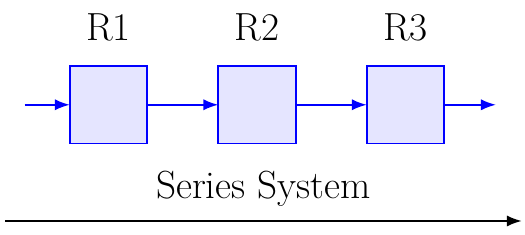
System Reliability in Series calculates the probability that all components in a series system operate successfully.
In a series configuration, the system fails if any single component fails.
When to use it
Use this formula when:
- Components must all work for the system to function.
- Evaluating production equipment reliability.
- Analyzing assembly lines or process chains.
- Comparing component reliability effects.
- Estimating total system survival probability.
Example
A production system has three critical components:
R1 = 0.98
R2 = 0.95
R3 = 0.97
Formula:
Rs = R1 × R2 × R3
Substitution:
Rs = 0.98 × 0.95 × 0.97
Rs = 0.9031
Result:
The system reliability is approximately 90.31%.
Applications
- Reliability engineering
- Maintenance planning
- Industrial asset analysis
- Production line reliability
- Risk assessment
Note
This formula assumes statistically independent component failures. If failures are correlated due to common causes, shared environments, poor maintenance, or process interactions, the real system reliability may differ from the calculated value.