
Variables
Description
What is this formula?
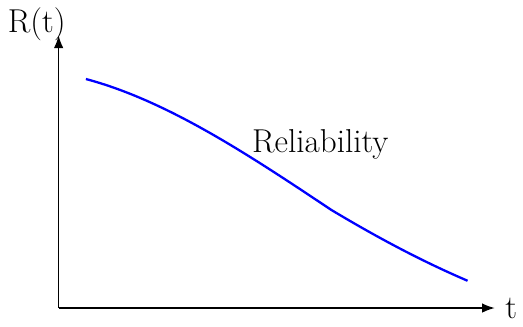
The Reliability Function calculates the probability that a component, machine, or system will continue operating without failure up to a specified time.
It is one of the most widely used models in reliability engineering and assumes a constant failure rate.
When to use it
Use this formula when:
- Evaluating equipment reliability.
- Estimating probability of survival.
- Planning preventive maintenance.
- Comparing equipment alternatives.
- Performing reliability analyses.
Example
A component has:
λ = 0.0005 h⁻¹
Determine its reliability after:
t = 1000 h
Formula:
R(t)=e^(-λt)
Substitution:
R=e^(-(0.0005×1000))
R=e^(-0.5)
R≈0.607
Result:
The probability that the component survives 1000 hours without failure is approximately 60.7%.
Applications
- Reliability engineering
- Maintenance planning
- Risk assessment
- Equipment lifecycle analysis
- Industrial asset management
Note
This model assumes a constant failure rate and corresponds to the exponential reliability distribution. Real equipment may exhibit infant mortality failures or wear-out failures, in which case Weibull or other reliability models may provide more accurate predictions.